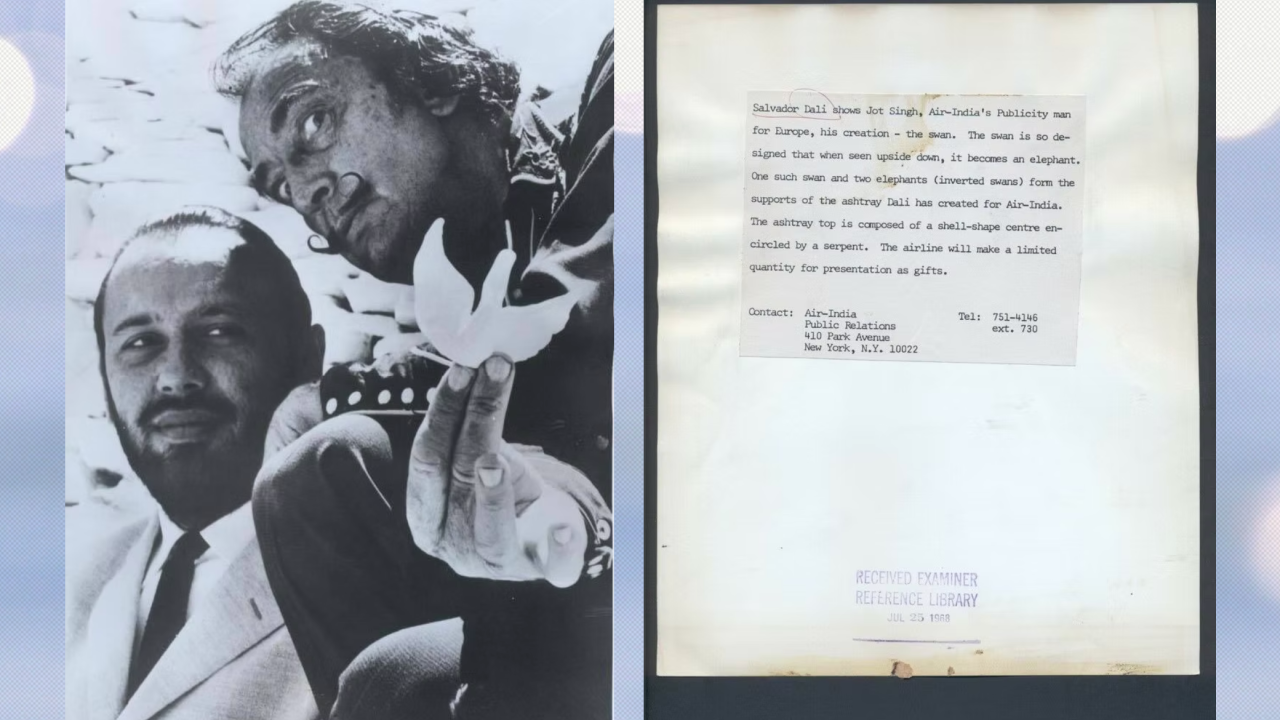
At the heart of a glass display in Bangalore’s National Gallery of Modern Art sits a surreal little object: a ceramic ashtray shaped like a swan—or is it an elephant? Designed by Salvador Dalí for Air India in 1967, it was given to first-class passengers as a gift. The airline paid the Spanish surrealist not in francs or rupees, but with a live baby elephant, flown from Bangalore to Catalonia with a mahout and an astrologer in tow.
In our current era of sterile in-flight menus and cost-cut cabin service, it’s hard to imagine an airline offering artwork as a boarding gift—let alone orchestrating a cross-continental pachyderm delivery to satisfy an artist’s whim. And yet, in the mid-20th century, Air India was doing exactly that: telling stories, trading in magic, and treating every passenger as a guest of the Indian imagination.
This wasn’t just marketing. It was myth-making. And it might just be the most extraordinary global brand India ever built.
Setting the Stage — A Brand Born Ahead of Its Time
Air India’s international service launched in 1948—barely a year after India gained independence. While the newly sovereign nation was still reeling from Partition, food shortages, and a chaotic transition of power, one of its companies was laying down jet routes to London, Cairo, and Geneva.
The vision came from J.R.D. Tata, who not only flew India’s first commercial flight in 1932 but also believed—radically for the time—that India could be represented to the world not through bureaucracy or diplomacy, but through hospitality, elegance, and design.
What emerged wasn’t just an airline. It was a flying embassy of postcolonial confidence. The cabins carried not just passengers, but purpose. Air India’s lounges were designed as Indian art galleries. Flight attendants wore handwoven sarees. In-flight menus featured regional cuisines explained with cultural flair. No detail was too small to be imbued with identity.
To walk into an Air India office in Paris or New York in the 1950s was to be immersed in a version of India that was intellectual, whimsical, and deeply self-assured. It wasn’t trying to be British. It wasn’t trying to be modern in a Western sense. It was creating a new aesthetic logic—one where Indian identity was not explained or defended, but celebrated without footnotes.
The Maharaja as Cultural Icon
In 1946, Air India’s commercial director Bobby Kooka and artist Umesh Rao conjured up a most unlikely mascot: a rotund, mustachioed Maharaja with a turban, a wry smile, and an uncanny ability to adapt. He could be seen meditating in Rishikesh, surfing in Australia, flirting in Rome, or bargaining in Cairo. Always charming, never explaining.
At first glance, he looked like a joke—an indulgent cartoon of bygone royalty. But in reality, he was the most effective cultural technology the brand ever produced.
To understand why, we turn to Douglas Holt, the scholar of iconic brands, who argued that the world’s most powerful brands don't just sell products—they resolve cultural contradictions. They become mythic figures, helping societies navigate identity shifts and historical trauma.
That’s exactly what the Maharaja did. India, newly independent, was grappling with how to be modern without abandoning tradition. The West expected bureaucracy, poverty, or mystical otherness. The Maharaja offered none of those. Instead, he offered playful charm. Self-assured dignity. He didn’t explain India to the world—he invited the world into India's imagination.
Air India wasn’t just an airline. It was exporting a mythic India—one that blended tradition with cosmopolitan wit, spirituality with sensuality, and heritage with humor. Through the Maharaja, India showed up not as a former colony, but as a civilizational force with its own brand of modernity.

The Irrational Genius of Air India
Why would an airline spend money commissioning Salvador Dalí to design ashtrays? Why offer coasters illustrated by R.K. Laxman? Why turn booking offices into Indian art salons, or fly a live elephant across continents just to fulfill a surrealist’s barter demand?
To most CMOs today, these moves would be dismissed as wasteful—off-brand, off-brief, off-budget. But to Rory Sutherland, they’d make perfect sense.
Sutherland, the behavioral economist and advertising contrarian, argues that most effective marketing isn’t rational—it’s psycho-logical. It doesn’t follow data; it follows human emotion. “The opposite of a good idea,” he says, “can also be a good idea.”
Air India’s decisions were masterpieces of psycho-logic. They didn’t optimize for cost. They optimized for memory, delight, and narrative velocity. When you gift an ashtray designed by Dalí—an object so strange it becomes lore—you don’t just create customer satisfaction. You create cultural currency.
Passengers remembered. Passengers told stories. In a pre-viral world, Air India went viral through sheer enchantment.
This is where modern marketers falter. Obsessed with metrics, we’ve lost our appetite for meaning. We A/B test copy lines but forget to ask: Will anyone care? Will anyone remember?
Air India didn’t care about conversion rates. It cared about conversation rates. And in doing so, it didn’t just sell tickets—it sold India.
World-Building at 30,000 Feet
Air India didn’t build a brand. It built a world.
In an era when most companies saw marketing as messaging, Air India saw it as mise-en-scène. The entire passenger journey—booking offices, check-in counters, lounges, meal trays—became a canvas for Indian aesthetics. But nowhere was this vision more striking than in its approach to art.
Instead of buying commercial prints or hiring decorators, the airline struck a simple, brilliant deal: it offered free tickets to emerging Indian artists in exchange for original artworks. Those artists included names that would soon become icons—M.F. Husain, Anjolie Ela Menon, B. Prabha, Tyeb Mehta.
What emerged from these exchanges was not a corporate art program. It was one of the most important private collections of modern Indian art in the world—hundreds of paintings and sculptures, many of which now reside in museums or are valued in the millions. At the time, they hung quietly in airport lounges and executive offices, unannounced. No press release. No virtue signaling. Just understated class and cultural confidence.
This was branding by osmosis. It didn’t tell you India was creative—it showed you. It embedded culture into steel and sky. It made every touchpoint not just functional, but symbolic.
Today, when brands outsource storytelling to influencers and equate identity with typography guidelines, Air India’s approach feels almost radical: use your platform to platform others. Let the artists carry your story. Let elegance whisper louder than marketing can shout.

The Collapse — And the Silence That Followed
I don’t fly Air India anymore.
Every few years, I give it another chance. And each time, I’m met with something worse than failure—indifference. No wheelchairs for the elderly. No trace of warmth. No ownership. It is not just the absence of service. It is the absence of soul.
This would be unfortunate for any airline. But for Air India, it is a cultural tragedy.
Because this wasn’t just an airline. It was a projection of India’s civilizational poise—our ability to enchant without explaining, to host without groveling, to assert without shouting. Its collapse didn’t just mark the decline of a carrier. It marked the disappearance of India’s last great act of brand imagination.
And here’s the real question—the one we have avoided for too long:
Since the Maharaja fell, what global brand has risen from India to take his place?
Where is our Hermès? Our Sony? Our Patagonia? Our Emirates? Not just companies. Symbols. Carriers of culture. Objects of desire that the world associates with a deeper sense of Indian-ness.
We’ve produced unicorns, yes. But have we produced mythology?
The answer is not just economic. It’s philosophical. Somewhere between liberalization and globalization, we became masters of scale and execution. But we stopped believing that Indian identity could be the center of gravity, not just a garnish.
The silence that followed Air India’s collapse isn’t just a branding vacuum. It’s a national pause. A failure of cultural confidence in product form.
And that’s what makes the Maharaja feel less like nostalgia and more like prophecy.
The Maharaja’s Final Lesson — A Manifesto for Brand India
Air India’s Maharaja era wasn’t a case study in branding. It was a case study in belief.
A belief that India could speak in its own voice. That elegance didn’t have to be imported. That storytelling was as much a tool of statecraft as diplomacy or defense.
The Maharaja wasn’t just a mascot. He was an argument. That you could make people fall in love with a country not through brochures or slogans, but through delight, whimsy, and dignity.
That’s the lesson we’ve forgotten. And it’s the one we most need to remember.
Because the world doesn’t need more Indian brands. It needs more Indian myths. Brands that don’t just optimize for CAC or distribution, but for emotional truth. Brands that aren’t embarrassed by eccentricity. Brands that don’t explain—but enchant.
If Air India’s legacy tells us anything, it’s this: we don’t need to borrow gravitas from the West. We don’t need to flatten our voice into global sameness. We’ve done it before. In 1948, no less.
The blueprint exists. We just have to believe we’re worthy of it again.