I say "morning" to my computer and five AI agents start working. One reads my email. One checks every project tracker for slipped deadlines. One preps each meeting on my calendar, pulling context from months of notes and past threads. One watches for patterns in team communication. One drafts the messages I need to send, in my voice, calibrated to each recipient.
Before my morning tea, I know what slipped, what's due, and what I'd forgotten. Ten projects across three time zones. Constant context-switching. When the devil lies in the detail, you can't afford to miss things. That fear is gone.
I'm a marketer. I can't write a line of code. Over the last few months, I've accidentally built an AI chief of staff.
How curiosity came back
For a long time, I used technology purely for business use cases. The genuine pull was missing. My excitement with software was always limited to photography and creativity. I spent my early twenties designing graphics in CorelDRAW, and that was the last time technology felt like a toy rather than a tool. Everything after that was use-case based: feeding convenience, feeding the business requirement. Never feeding curiosity.
Until ChatGPT.
In 2024, my doom-scrolling time on Instagram migrated to GPT. I'd describe it as search-plus-plus, and what made it addictive was the sheer diversity of where your mind could go. In a single session I'd move from marketing strategy to Shaiva philosophy to the latest in AI research to a question about astrophysics to a deep dive on screenwriting craft to something I'd read about behavioural economics. The range was extraordinary. You could bring any level of knowledge to any subject and it would meet you where you were, fill in the gaps, and push you further. It became a thinking partner for curiosity across topics I'd never have explored in one sitting.
This was before it could even browse the web. Just me and whatever the model knew. And still, something had shifted. I was learning again, not for a meeting or a presentation, but because I wanted to know. That part of me had been in the background for twenty years. AI brought it to the foreground.
But it couldn't help me with work. Not yet.
My friend Mayank from EPYC became my first AI teacher. He taught me Cursor and guided me through the build of my website: dograworkshop.com, what I call my explorations into "the source code of humanity." Photography, writing, ideas, field notes. A marketing guy with opinions about deployment pipelines. (My team found this amusing. They still do.)
This was the basic start. And from here, the question became: can this go beyond research? Beyond side projects? Can it actually do things for the work I do every day?
The big unlock: Obsidian and Claude Code
Two things changed everything, and I want to explain why, because the combination matters more than either tool alone.
Obsidian is how I store knowledge. Every note links to every other note: meeting records connect to project files, which connect to team member profiles, which connect to the feedback I gave them last month. It builds a web of context the same way memory works. One thought triggers another. And it's all plain text markdown files on my own machine. Not in someone else's cloud. Not locked in a proprietary format.
My vault has grown to over 200 files and 300,000 words. Every active project has a dedicated file that updates daily with decisions, open questions, and status changes. It's a living local wiki of everything I know and everything I'm responsible for.
Claude Code is what operates inside that vault. It's Anthropic's AI tool, and what makes it different from ChatGPT or anything else I've used is that it works inside your actual computing environment. It reads your files, scans your email, checks your calendar, searches across everything you've written. It doesn't live in a browser tab. It lives where your work lives.
And because it can see the full web of connected context across my vault, it becomes something genuinely different from a chatbot. It feels less like a tool and more like a colleague who has actually done the reading. It flags a slipped commitment from last week because it read the meeting notes, checked the tracker, and noticed I hadn't followed up. That's not search. That's a chief of staff.
The system I built
I call it Life OS.
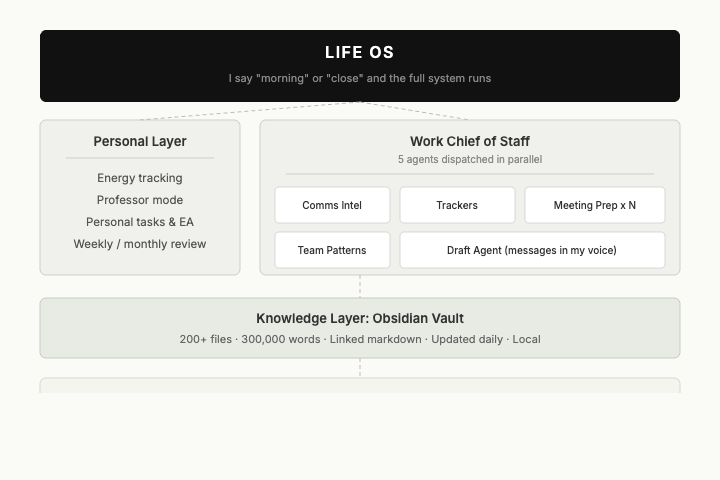
Two layers. A personal layer handles energy tracking, learning, and personal tasks. A Work Chief of Staff dispatches five agents every morning in parallel: comms intelligence, tracker review, meeting prep (a separate agent per meeting, each pulling its own context), team pattern analysis, and a draft agent that writes messages based on what the others found. The evening close reviews what happened, what's still open, what I committed to, and whether I delivered.
The personal layer has its own depth. A professor mode lets me drop into a micro-learning session on anything: AI architecture, Shaiva philosophy, screenwriting craft, marketing theory. Taught from primary sources, at genuine depth, calibrated to what I already know and where I left off last time. For someone who rediscovered curiosity through AI, this feels like the system was designed for me.
The skills
I've been building custom skills for nearly every part of how I work. Each skill is a set of instructions that teaches the AI how to handle a specific type of task with all the context and standards I care about. And this is where it gets genuinely interesting, because the range of what you can build is much wider than most people imagine.
One skill drafts emails in my voice, adjusted for the recipient and the relationship. One preps me for difficult conversations with specific team members, drawing on months of interaction data. One manages my task system and delegates to my EA. There are skills for travel planning, for all my writing, for coaching prep, for team health analysis.
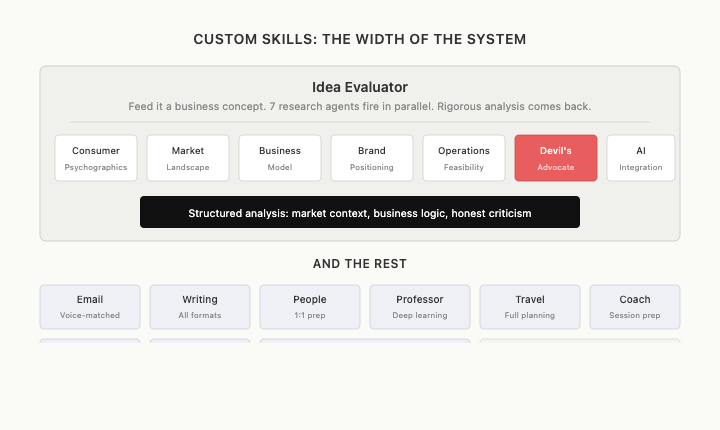
The idea evaluator was a revelation. I feed it a business concept and seven research agents fire in parallel: one analyzing the consumer psychographics, one mapping the competitive market, one stress-testing the business model, one evaluating brand positioning, one assessing operational feasibility, one dedicated devil's advocate attacking the concept from every angle, and one assessing the AI integration opportunity. What comes back isn't a summary. It's a structured, rigorous analysis with market context, business logic, and honest criticism. I've used it on ideas ranging from a luxury eldercare concept to a curated travel platform, and the depth of what it produces has genuinely surprised me.
I built an AI writers room: a full pipeline for developing original television series from concept through pilot screenplay through pitch deck. Eight skills, each handling a creative phase, with research agents, world-building, character architecture, and a devil's advocate that attacks every premise. Built in a day. Twenty files. We're expanding this across every function of our team.
I'd built this local wiki pattern, markdown files as a structured knowledge base, independently, because it made sense for how I work. A few weeks later, Andrej Karpathy, who built the AI teams at Tesla and OpenAI, published an article describing the same architecture.
For the first time in my life, I felt tech literate. That felt good.
Craft over code
This is the part that matters.
Our goal has been to build an AI-first marketing team. Not AI-curious. AI-first. Absolutely ahead of the curve on understanding what's actually possible, not what the conference slides say is possible.
Recently, we ran a creative immersion with our film team, bringing in creators working at the edge of AI and craft. The question was: what changes, and what doesn't?
Craft becomes more important. Not less. Generating competent content is trivially easy now. A thousand words on any topic, structured, grammatically clean. Completely forgettable. What AI cannot supply on its own is the sliver of insight that separates work from content. The thing you noticed because you were actually there, the connection you made because you've spent twenty years in the room.
If you don't know your craft, AI gives you faster slop. If you do, it opens up a level of creative work that wasn't possible before.
I don't write code. I write briefs.
What this actually means
I'm at 2% of what this can do. Every week something rearranges how I think about my own work.
The people who will use AI best are not the ones who understand the technology. They're the ones who understand their own work. Twenty years of domain expertise, the taste you've developed, the judgment you exercise without thinking about it. That is what AI amplifies. Without it, you get content. With it, you get work.
AI didn't make me more productive. It made me curious again. It reconnected me with the twenty-two-year-old in CorelDRAW, building things just to see what he could make.
My wife thinks I'm becoming the protagonist of "Her." She may not be wrong.
Thank you to my AI teachers, especially Mayank from EPYC, and colleagues at Accel who showed me what was possible.