The Singing Boatman of Banaras
They tell you Banaras will make you surrender. Not in the spiritual-poster sense. In the practical one. Your plans will fall apart and the city will hand you something you didn't ask for.
We'd just finished the Ganga Aarti at Assi Ghat. I was travelling with four senior citizens — both sets of parents, one with a knee replacement, another with a pacemaker. A trip planned to the half-hour. And then it rained. No forecast had called for it. No umbrellas. We sat on the open boat, slightly wet, a little irritated, easing into a sunrise ride that wasn't starting the way I'd scripted it.
The Ganga at dawn is not quiet. Twenty boats running engines. Speakers on half of them blasting recorded bhajans at nightclub volume. Devotion as bass drop. My guide Anupam leaned over and mentioned, almost as an aside, that our boatman was also an accomplished singer. His name was Bhoomi Nishad.
I looked at the man at the engine and tried to reconcile the claim with the noise around us. I nodded and moved on. There was too much happening to hold — the aarti still ringing in my ears, the river wide and grey in the early light, parents pointing at ghats they'd only seen in photos.
The boat turned toward Manikarnika.
If you haven't been to Banaras: Manikarnika is the cremation ghat. Pyres burn here without pause. They have for centuries, possibly millennia. Hindus come here to die, because to die in Kashi is to be released from the cycle of rebirth. Shiva himself is said to whisper the Tarak Mantra into the ears of the dying. It is the most consequential stretch of riverfront in Hinduism.
Our boatman parked us just off the ghat. The pyres were burning. Smoke rose slow and vertical in the still morning air. Wood stacked in careful pyramids. Families at the water's edge. He cut the diesel engine.
Silence. Or what passes for it in Banaras: the river against the hull, wood cracking in the fire, a low murmur of Sanskrit.
And then Bhoomi Nishad began to sing.
It was a Shiv bhajan. The notes were precise, the arrangement layered and complex. The kind of singing that cannot be taught — not technique drilled into muscle memory, but something that comes from inside a person and flows through them without permission. Bhoomi has never had a day of formal musical education. He sings bhajans, kajris, thumris — learned on the water, not in a classroom. I looked at my parents beside me. The light on the river, the smoke from the pyres, and this voice. The most beautiful bhajan I have ever heard.
He finished. Went quiet. Anupam began to explain why so many people wish to die in Banaras — the Tarak Mantra, the promise of moksha, release from the cycle.
Bhoomi, still at the oar, said simply that he didn't believe it.
I said that Kabir — another great son of this city, a weaver who became one of India's most radical poets — didn't believe it either. My own position is plain: you can't live your life a certain way and then come to a ghat expecting a reboot. That's my problem with a lot of structured religion. The escape hatch.
Nobody argued. We were three men on a boat at a cremation ghat, looking at pyres that have burned without interruption for centuries, each holding a different view of what the fire means. The bodies were burning regardless. You look at the smoke and you wonder about the purpose of all of it. The plans. The schedules. The medications.
And in that silence, with all our contradictions sitting alongside each other, Bhoomi smiled. And sang again.
This second song was different. Looser. More playful. But the same quality underneath — not performative, not for us. The singing came from within, and it sounded like it. I don't have a better way to say this. Some singing is skill. This was something flowing through a person who had no interest in holding onto it.
He lives at Nishad Ghat. The ghat gave him his surname, or his community gave the ghat its name. They've been here long enough that it doesn't matter which came first. Ten thousand Nishads live in the settlement around the ghat. They are boatmen. They have been boatmen on this river for as long as anyone can trace.
And they will tell you exactly how long. In Tulsidas's Ramcharitmanas — written in this city, five centuries ago — there is a scene the community carries as its founding story. When Ram, Sita, and Lakshman needed to cross the Ganga during their exile, it was a Nishad boatman who carried them. His name was Kevat. Before letting Ram step aboard, Kevat insisted on washing his feet. His reasoning was practical: he'd heard that the dust from Ram's feet had once turned a stone into a woman, and he was not going to risk the same thing happening to his wooden boat.
When Ram offered payment, Kevat refused. His answer has lived in the language ever since: we do the same work. I ferry people across this river. You ferry them across the bhav-sagar — the ocean of existence.
Ram embraced him.
There is a temple at Nishad Ghat today, dedicated to that boatman. The Nishad Raj Temple. No institution built it. No government erected it. The boatmen built a temple to the boatman who carried God.
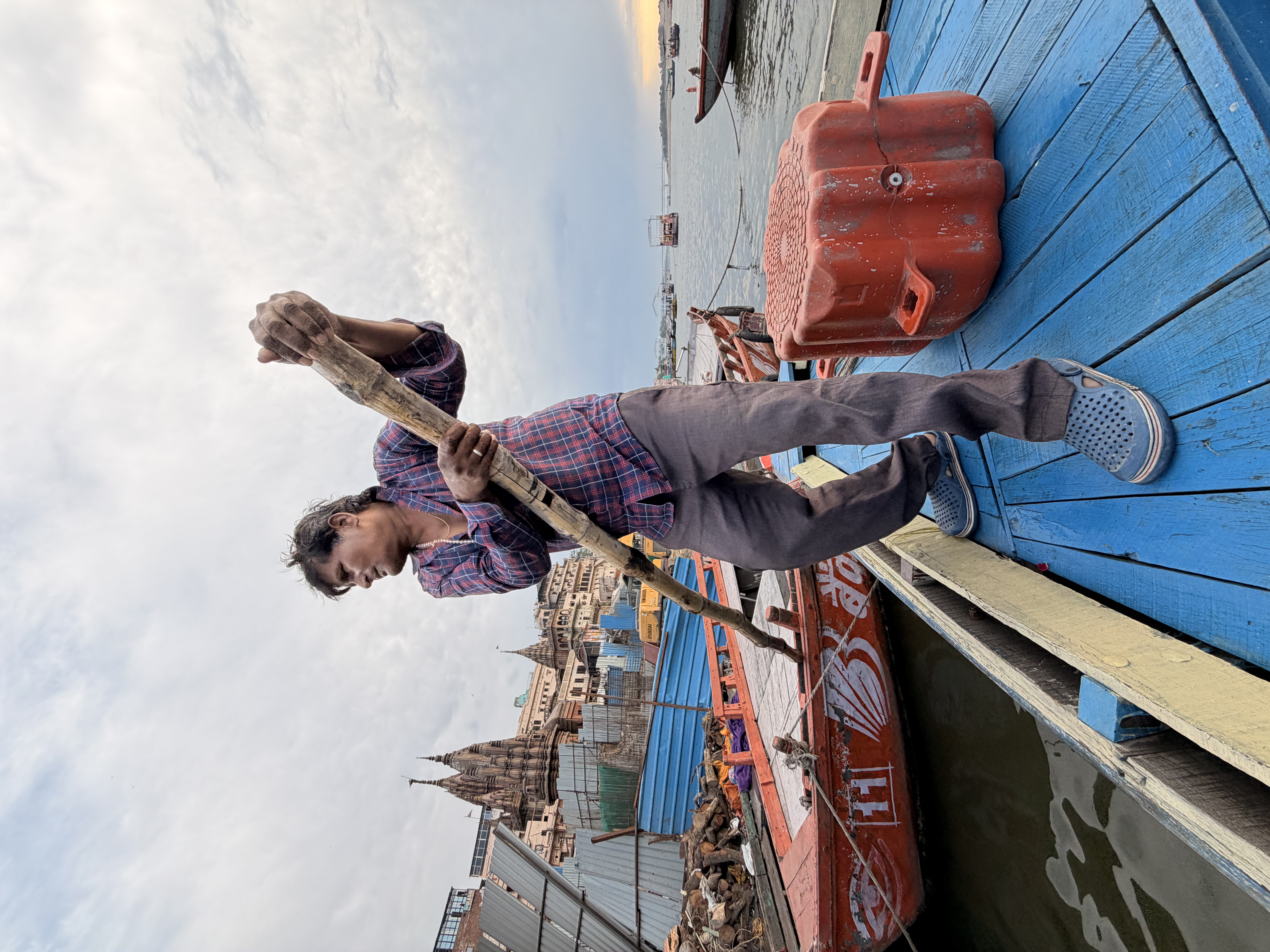
Bhoomi Nishad on the Ganga, April 2026
I knew none of this when I was on that boat. Banaras throws a thousand things at you before breakfast, and I was trying to absorb all of them.
The same community that carried Ram was classified by the British as a criminal tribe. After independence, they lost sand mining, fishing, and riverbed cultivation to environmental regulations that curbed the small operator while the sand mafia continued without disruption. Today, roughly two thousand Nishad boatmen share eight hundred boats under hereditary licenses. Water taxis imported from Gujarat are arriving to claim what's left.
Later, I asked Bhoomi what makes Banaras what it is.
He didn't reach for a philosophy. No rehearsed answer. He said: "Banaras hai Bana Hua Ras. Har cheez mein ras mila hai." Banaras is already made of ras — of flavour, of essence, of juice. Everything here has it mixed in already.
And: "Har admi guru hai." Everyone is a guru. That's why he greets every person who steps onto his boat with "Kaise ho, guru?" Not a pleasantry. A way of seeing.
I think that's the thing I keep carrying, weeks later. Bhoomi Nishad is not hidden talent waiting to be found. He is not waiting for anything. He has taken the music of this city — its bhajans, its kajris, its ragas — and folded them into his everyday life. He sings on the river before dawn. He greets every passenger as a teacher. He argues about the afterlife at a burning ghat and then sings again, because that's what the moment asks for.
He has found a way to make every morning beautiful. Without a stage, without a credential, without anyone's permission. Bana hua ras. The essence was always there. He just sings it.
I came for a sunrise boat ride. Banaras handed me this instead.
Someone told me something during those days in Banaras. I don't remember who. I don't remember which ghat we were standing on. But I remember what they said.
The gods don't live in the temples in Banaras. They live on the ghats.
I think the best of its talent does too.
More from Bhoomi
Bhoomi Nishad sings on the Ganga every morning. You can find him at Nishad Ghat. To arrange a boat ride with Bhoomi, contact Anupam at Roobaroo Walks: +91 94541 34362.
People
Bhoomi Nishad
The singing boatman of Banaras. Sings bhajans, kajris, thumris — self-taught. Lives at Nishad Ghat.
Anupam
Guide, Roobaroo Walks. BHU scholar with a photographer's eye for the city. Contact: +91 94541 34362.
Recommended
Boat ride with Bhoomi Nishad
wanderRequest Bhoomi specifically through Anupam at Roobaroo Walks. Sunrise ride recommended — ask to stop at Manikarnika.
Nishad Ghat
wanderThe boatmen's ghat. Nishad Raj Temple built by the community. Ten thousand Nishads live in the settlement.
Roobaroo Walks
wanderAnupam's walking tours of Banaras. BHU scholar, deep knowledge of the city's history and lanes.